_edited_edited_edite.png)
Spinal Stenosis Treatment in Naples & Marco Island
If you have been diagnosed with spinal stenosis — or if leg or arm symptoms that come on with standing, walking, or specific positions have been linked to spine narrowing on imaging — this page describes how we evaluate and treat the condition at Timeless Interventional of Naples, with focused interventional approaches for both lumbar and cervical stenosis.


SYMPTOMS
Lumbar versus cervical stenosis.
Lumbar spinal stenosis is the most common form. It typically presents with neurogenic claudication — a pattern of leg pain, heaviness, numbness, or weakness that comes on with walking or standing, eases with sitting or forward bending, and is usually felt in both legs (though it can be asymmetric). The classic clue is that patients feel better leaning over a shopping cart or walking uphill, both of which flex the lumbar spine and open up the central canal.
Cervical spinal stenosis can produce arm symptoms (cervical radiculopathy) when the lateral recess or neural foramen is the primary site, or signs of spinal cord compression (cervical myelopathy) when the central canal is significantly narrowed. Myelopathic symptoms — hand clumsiness, gait imbalance, problems with fine motor tasks — are a more urgent finding and require careful evaluation.
OVERVIEW
What spinal stenosis actually is.
Spinal stenosis is narrowing of one or more spaces within the spine. The most clinically important spaces are the central canal (where the spinal cord and the cauda equina nerve bundle travel), the lateral recess (just to the side of the central canal, where individual nerve roots begin to exit), and the neural foramen (the opening through which each nerve root leaves the spine to travel to the body). Narrowing in any of these spaces can compress the nerves passing through, producing pain and neurologic symptoms.
Stenosis is typically the result of long-term degenerative change. As discs lose height, ligaments thicken (particularly the ligamentum flavum), and facet joints hypertrophy, the available space for nerves gradually decreases. It tends to develop slowly over years, which is part of why patients adapt around it for so long before seeking care.

Blausen.com staff (2014). "Medical gallery of Blausen Medical 2014". WikiJournal of Medicine 1 (2). DOI:10.15347/wjm/2014.010. ISSN 2002-4436., CC BY 3.0 <https://creativecommons.org/licenses/by/3.0>, via Wikimedia Commons
THE IMAGING QUESTION
Why your MRI may not explain your symptoms.

Spinal narrowing shows up on the MRIs of a large share of adults over 60 who have no symptoms at all — it's one of the most common incidental findings in the aging spine. So a report that says "stenosis" does not, by itself, explain your pain. What matters is whether your symptom pattern matches the anatomy: the positional leg or arm symptoms, the walking tolerance, the exam findings. Real stenosis pain has a signature — it comes on with standing or walking and eases when you sit or lean forward. We treat that clinical picture, confirmed against your imaging — not the MRI report on its own.

EVALUATION
How spinal stenosis is diagnosed.
Diagnosis is clinical and imaging-based. A detailed history identifies the characteristic positional pattern. An exam looks for neurologic signs, gait abnormalities, and patterns that point toward the involved level. MRI is the imaging modality of choice for evaluating the canal, lateral recess, and foramen at each level. In some cases, electrodiagnostic studies (EMG/NCS) can help distinguish stenosis from peripheral neuropathy or other nerve conditions.
TREATMENT
Modern treatment of spinal stenosis.
Treatment is layered, with the goal of restoring function and reducing pain without proceeding to surgery unless necessary.
Targeted physical therapy is foundational. Therapy for lumbar stenosis emphasizes flexion-biased exercises, core stabilization, and aerobic conditioning that respects the patient's positional limits. Cervical stenosis benefits from posture work, neck stabilization, and avoidance of provocative positions.
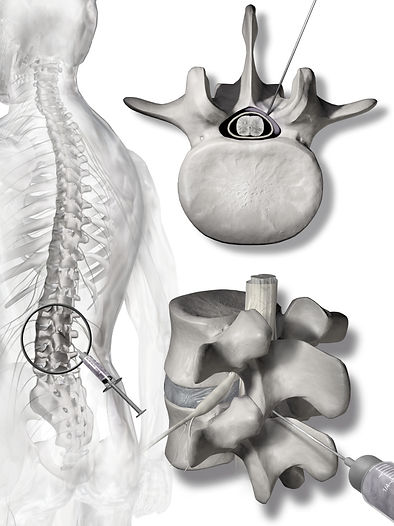
Image-guided epidural steroid injections are the cornerstone interventional treatment. The two main approaches are interlaminar epidurals (delivered between vertebrae into the epidural space) and transforaminal epidurals (delivered selectively to a specific nerve root). The choice depends on the involved level, the pattern of symptoms, and the anatomy. Relief typically lasts weeks to months and can be repeated as part of a long-term plan.
Nerve-modulating medications and addressing central sensitization play a supporting role, particularly for patients who have lived with stenosis for years.
Surgical decompression is appropriate when neurologic deficit is progressing or when interventional and conservative options have not provided adequate relief. We coordinate with spine surgical colleagues when surgery is the right next step.
WHAT TO EXPECT
Realistic expectations.
For most patients, a well-targeted transforaminal injection reduces leg pain enough to move, sleep, and rehab effectively — sometimes within days, sometimes over a couple of weeks as inflammation settles. Relief can last months; some patients need a short series, and a smaller number need surgery when there's significant nerve compression. The goal is honest: calm the irritated nerve, restore function, and avoid unnecessary procedures — while being straight with you about when surgery genuinely is the better path.
GOOD TO KNOW
Frequently asked questions
WHAT DOES SPINAL STENOSIS FEEL LIKE?
Classic lumbar stenosis causes leg pain, heaviness, or numbness that comes on with standing or walking and eases when you sit or lean forward — many people notice they're comfortable leaning on a shopping cart. Cervical stenosis can cause arm symptoms or, less commonly, balance and coordination changes that need prompt evaluation.
CAN SPINAL STENOSIS BE TREATED WITHOUT SURGERY?
Yes — most patients are managed without surgery. Targeted physical therapy, image-guided epidural steroid injections, and medication can meaningfully improve walking distance, sleep, and daily comfort. Surgery is reserved for progressing neurologic deficits or symptoms that don't respond to a well-designed non-surgical plan.
DO EPIDURAL INJECTIONS HELP SPINAL STENOSIS?
For many patients, yes. Image-guided epidural steroid injections deliver anti-inflammatory medication precisely to the narrowed, irritated area, and relief typically lasts weeks to months and can be repeated as part of a longer-term plan. They're often what allows a patient to stay active and delay or avoid surgery.
IS SPINAL STENOSIS SERIOUS?
Most lumbar stenosis is a quality-of-life problem rather than a dangerous one, and it's very manageable. Certain cervical findings — signs of spinal cord compression — are more urgent, which is why a careful exam matters. A proper evaluation sorts out which situation you're in.

THE NEXT STEP
Our approach.
Dr. Chaturani Ranasinghe, MD is a double board-certified anesthesiologist and interventional pain physician with deep experience in image-guided spine procedures, serving Naples, Marco Island, and greater Southwest Florida. If standing or walking has become limited by your back or legs, the best next step is a simple conversation about whether a targeted, image-guided approach can help.
Already get these injections, or here for the season? With recent imaging, we can often evaluate and treat you the same day or next — no insurance pre-authorization wait.