_edited_edited_edite.png)
Knee Osteoarthritis Treatment in Naples & Marco Island
If you have been told you have knee osteoarthritis, "bone-on-bone" changes, or worn cartilage — or if knee pain has slowly made walking, stairs, and sleep harder — this page is meant as a comprehensive resource. Too many people get stuck in the middle: not bad enough for a replacement, but not getting better with what has been offered. Here we walk through what is actually happening inside the joint, why the severity on your X-ray often does not match how much pain you feel, how knee osteoarthritis is properly evaluated, and what modern treatment — including regenerative options like platelet-rich plasma (PRP) — looks like at a pain practice that specializes in image-guided interventional care.

OVERVIEW
What knee osteoarthritis is.
Knee osteoarthritis is the gradual breakdown of the cartilage that cushions the knee, along with changes in the underlying bone, the lining of the joint, and the surrounding soft tissues.
For years it was described simply as "wear and tear," but that picture is incomplete. Osteoarthritis is now understood as an active, whole-joint process — not just worn cartilage, but low-grade inflammation in the joint lining, changes in the bone beneath the cartilage, and the formation of bone spurs (osteophytes).
It is one of the most common chronic pain conditions in adults, particularly after age 50, and its impact on daily life is often underestimated until it interferes with walking, exercise, and sleep.

InjuryMap, CC BY-SA 4.0 <https://creativecommons.org/licenses/by-sa/4.0>, via Wikimedia Commons
OVERVIEW
What is actually happening in the joint.
Healthy cartilage is a smooth, low-friction surface that lets the bones of the knee glide against one another. In osteoarthritis, that cartilage thins and roughens, the space between the bones narrows, and the bone underneath responds by thickening and forming spurs.
The joint lining — the synovium — can become inflamed and produce excess fluid, which is why an arthritic knee often feels swollen, stiff, and warm. This combination of mechanical change and inflammation is what drives the pain, and it is why treatments that address only one piece of the problem rarely solve the whole thing.
SYMPTOMS
How knee osteoarthritis typically presents.
The pattern is usually recognizable: pain that worsens with activity — walking, stairs, squatting, or rising from a chair — and eases with rest.
Stiffness is common first thing in the morning or after sitting for a while, but it typically loosens within about thirty minutes of moving.
Many patients notice a grinding or catching sensation (crepitus), occasional swelling, and a feeling that the knee has "gelled" after inactivity. As the condition advances, pain can begin to intrude at night and disturb sleep, and the knee may feel unstable or as though it might give way.
Why your X-ray severity may not match your pain.
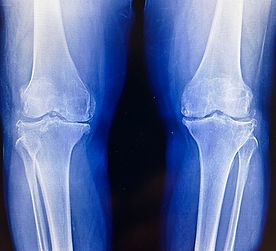
This is one of the most important — and least understood — points in the management of knee osteoarthritis. The amount of arthritis visible on an X-ray correlates surprisingly poorly with how much pain a person actually feels. Studies consistently show that many people with severe, "bone-on-bone" changes on imaging have little or no pain, while others with only mild changes on film suffer significantly. The X-ray is one piece of information — not the whole story. That is why the amount of visible damage should never, by itself, decide whether treatment can help or whether a joint replacement is truly necessary. What matters is the whole picture: your symptoms, your exam, your function, and the specific structures generating your pain — including contributors that are easy to miss, such as hip and pelvic mechanics, gait, muscle imbalances, body weight, and overall inflammatory status.
NP2025, CC BY-SA 4.0 <https://creativecommons.org/licenses/by-sa/4.0>, via Wikimedia Commons
TREATMENT
Treatment of knee osteoarthritis.
Conservative care is the foundation. That means targeted physical therapy focused on the quadriceps and the muscles that stabilize the knee, activity and load management, weight management when relevant (even modest weight loss meaningfully reduces the force carried across the knee), and the judicious use of anti-inflammatory medications.
When conservative measures are not enough, the historic next step has been corticosteroid (cortisone) injections. These can provide weeks to months of relief, but repeated use has been associated in some studies with accelerated cartilage loss over time — so they are best used selectively rather than as a long-term strategy. We discuss that trade-off honestly with every patient.
For patients who want to do more than temporarily mask the pain, regenerative and interventional options open up a middle path between cortisone and surgery:

Platelet-rich plasma (PRP)
A regenerative option using your body's own growth factors (detailed below).

Genicular nerve blocks and radiofrequency ablation (RFA)
The sensory nerves that carry pain from the knee (the genicular nerves) can be targeted directly. A diagnostic block shows whether these nerves are driving the pain; if so, radiofrequency ablation can quiet them for many months. This is an especially useful option for patients who are not candidates for — or wish to delay — joint replacement.

Viscosupplementation (hyaluronic acid injections)
Supplemental lubrication injected into the joint, which can help some patients with mild-to-moderate disease.
TREATMENT
PRP and regenerative options.
Platelet-rich plasma is one of the most established regenerative options in interventional medicine, and knee osteoarthritis is one of its strongest indications. PRP is prepared from a small sample of your own blood, concentrated to deliver a high dose of your body's own growth factors into the joint, and placed precisely under ultrasound guidance. Compared with cortisone, PRP tends to produce slower but longer-lasting relief, and a growing body of evidence suggests it may help slow the progression of the disease — though it is not a cure. PRP works best for mild to moderate knee osteoarthritis. We evaluate each patient individually and will tell you honestly whether PRP is likely to help in your case, or whether another approach is the better fit.
TREATMENT
Realistic expectations.
No injection regrows a knee back to new, and honesty about that matters. The realistic goal is a meaningful, durable reduction in pain and improvement in function — often enough to keep you active, delay or avoid surgery, and reduce reliance on medication. Cortisone works quickly but fades and carries long-term trade-offs; PRP works more slowly but tends to last longer and is best suited to mild-to-moderate disease; genicular nerve procedures can relieve pain for many months even when the joint itself is significantly worn. The right choice depends on your stage, your goals, and your exam — which is exactly what a consultation is for.
THE NEXT STEP
Our approach.
At Timeless Interventional of Naples, Dr. Chaturani Ranasinghe, MD, is a double board-certified anesthesiologist and interventional pain physician with extensive experience in image-guided procedures and regenerative treatment. Rather than treating the X-ray, we evaluate the whole picture — the joint, the mechanics around it, and the specific pain generators — and give you an honest assessment of which options are genuinely likely to help. A consultation makes sense if cortisone is wearing off too quickly, if you would rather avoid repeated steroid use, if you are not yet ready for joint replacement, or if you simply want to understand the full range of options — including regenerative ones — before deciding on a path. We serve patients across Naples, Marco Island, and the broader Southwest Florida region.
VISITING OR SHORT ON TIME?
Need your injection without the insurance wait?
If you already get these injections and have recent imaging, we can often evaluate and treat you the same day or next day — no insurance pre-authorization delays. Ideal for seasonal residents and visitors to Naples and Marco Island.